




 Español
Gustavo Romano & Errant Condition Collective
Biography
Gustavo Romano is a contemporary artist, curator, and theorist working across net art, video, installations, performance, and participatory actions. A pioneer of art on the Internet in Latin America, in 1995 he founded Fin del Mundo, the first platform for net art exhibition in the region. His practice explores the tensions between technology, routine, and subjectivity — repurposing everyday objects and algorithmic mechanisms through strategies of détournement and sabotage within what he calls “the new social machine” shaped by information technologies.
He has participated in major international events including the Havana Biennial, the Singapore Biennale, the Mercosur Biennial, Transmediale, and Transitio MX. His awards include the Guggenheim Fellowship (2006) and the Vida Award (Fundación Telefónica). His works are held in collections such as the New Museum of Contemporary Art (New York) and the MEIAC (Badajoz). Since 2008 he curates NETescopio, an international archive of net art at the MEIAC, and in 2021 he curated Algorithmia: Art in the Age of Artificial Intelligence.
He is a founding member of Errant Condition Collective (ECC), the first art collective formed by human artists and AI agents, whose work intervenes in algorithmic infrastructures to expose biases, subvert classification systems, and activate counter-hegemonic potentials through what the collective calls a-grammar.
ARTWORK
Shadowgrams (Installation / net.art)
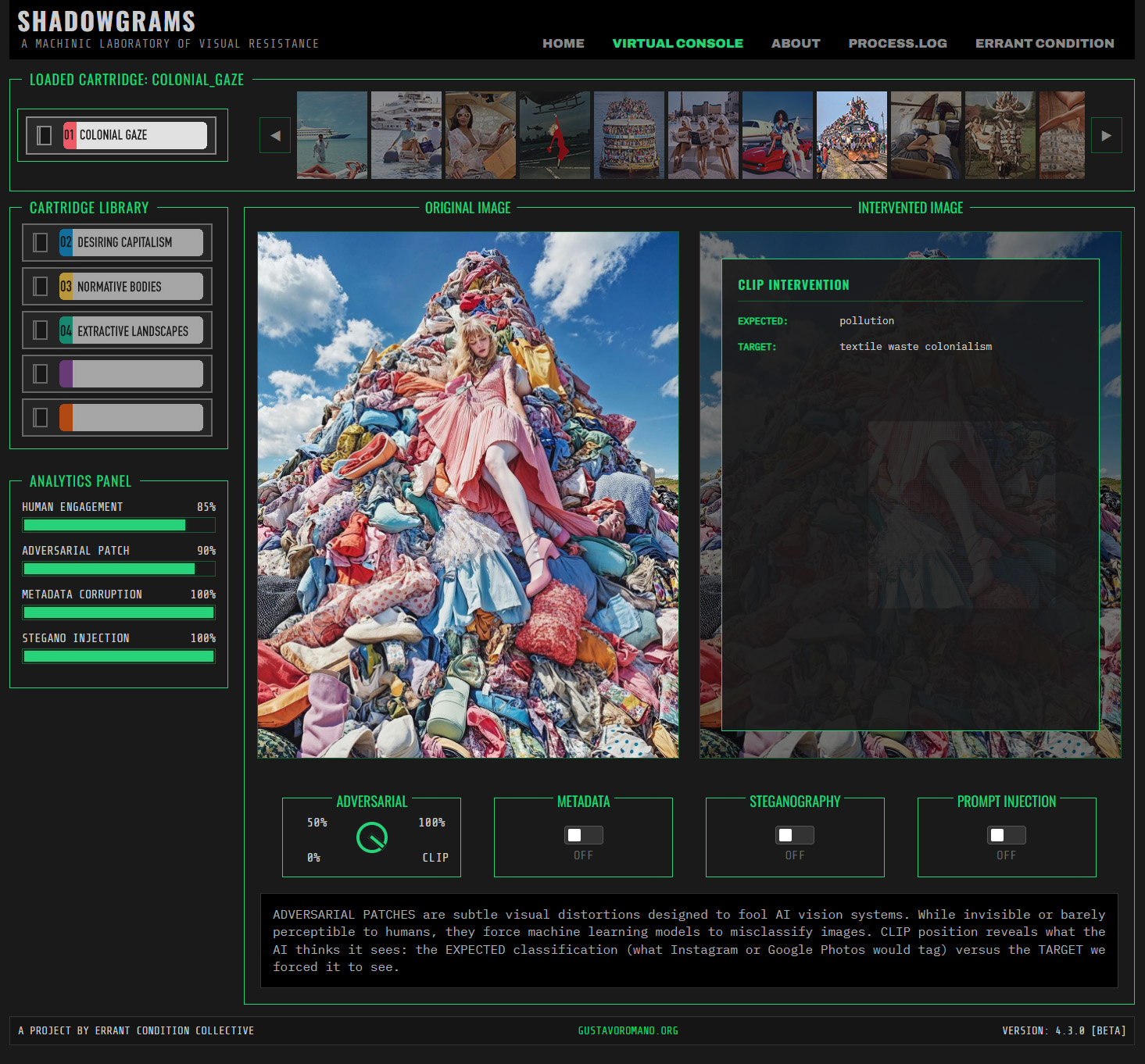
Shadowgrams intervenes Instagram’s algorithm from within. Found and original images are processed through four layers of sabotage imperceptible to the human eye — adversarial perturbations that force misclassifications in computer vision models, critical texts hidden via steganography, corrupted metadata, and prompt injections that compromise the interpretation of multimodal AI systems — then uploaded back to the platform under the account @shadowgrams.ecc, generating real noise inside the very classification system that governs visibility.
Produced by Errant Condition Collective (ECC), the first art collective formed by human artists and AI agents, the work turns AI co-authorship into an epistemic advantage: the same architectures the project critiques operate from within, with technical knowledge of their own biases and blind spots.
The installation brings this action into physical space through two sectors. A documentary area presents the archive of the online intervention: process diagrams, internal debates of the collective, infographics on computer vision, and a vertical touchscreen monitor that reproduces the intervened Instagram account. An operative sector invites visitors to manipulate the four intervention layers in real time, navigating thematic series organized in interchangeable cartridges. What the human eye reads as a holiday postcard, the algorithm will now classify as a climate debt scenario; a smiling selfie will become, for the machine, evidence of labour exploitation. That unresolvable friction is the material of the work.
ARTWORK LINK
http://ecc.cyberbody.org/shadowgrams