
 Español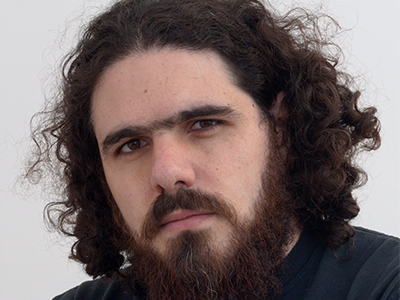
Diego Trujillo Pisanty
Biography
Diego Trujillo Pisanty (Mexico City, 1986) is an artist working with information as both a concept and a material. His past work has explored how information is captured, stored, transmitted, interpreted, and destroyed. He is also interested in the role that information plays in shaping identity, politics and our understanding of nature.
Trained originally as a photographer, Diego then undertook studies in biology at Mexico’s National University (UNAM) and later received an MA degree in Design Interactions from The Royal College of Art. His interdisciplinary background has led to an art practice where empiricism, experimentation and technology often drive the concept and execution of the work.
Diego’s work has been exhibited internationally in the U.S.A, Germany, Ireland, U.K., France, and Mexico and has also received worldwide press coverage. He has been awarded the Lumen Prize in the Still Image category, an Honorable Mention in Hybrid Art at the Prix Ars Electronica and has thrice been a Young Creators Fellow from the Mexican Government.
Apart from his art practice Trujillo Pisanty has also worked as a researcher in Human-Computer Interaction and as a lecturer in physical computing, robotics and smart materials.
Website
http://trujillodiego.com
“Uncertainty & Collapse”
Installation
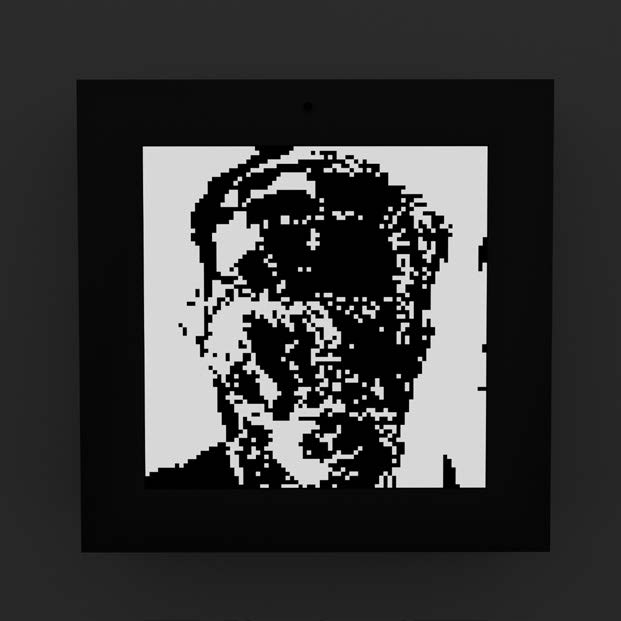
Uncertainty & Collapse is an artwork using quantum computing to generate images about ongoing crises. Its title references Heisenberg’s Uncertainty Principle and wavefunction collapse suggesting that these two words also speak to the state of a world where climate change, war, inequality, displacement, and border issues exist in a suspended state between unrealized threat and lived reality. The piece relies on custom software that calculates the probability of a pixel being either black or white across a dataset of images scraped from news sources relevant to the local communities where the work is being exhibited.
These probabilities are encoded as qubit states on real quantum hardware where measurement causes the quantum state to collapse into either a black or white value. The possible images depend on the news cycle and shift constantly, revealing a fragmented, evolving portrait of the world that embraces uncertainty in its aesthetics and production process.
When visitors encounter the piece, they see a flickering LED display module. Above the panel is a small camera that detects a visitor’s gaze, when seen the screen generates a new image. When ignored for some time, it returns to flickering.
Uncertainty and Collapse pioneers the adoption of quantum computing in digital art by exploring how quantum ideas can encourage us to observe in minute detail in order to reduce ambiguity. The fact that the piece’s code is being developed by an artist resists traditional engineering metrics of clarity, efficiency, and legibility. It proposes an alternative relationship to technology that invites us to look, knowing that the act of looking alters what is seen.